Showing posts with label Wind Turbine. Show all posts

Jul 13, 2021

Design and Analysis of Wind Turbine Tower

Design of Wind Turbine Tower

The tower of a wind turbine is not only a constructional member which is there to endure the static and dynamic load of the wind turbine system. 

Keeping in view the high weight of the nacelle and the heavy operational load of the turbine, turbine tower designing is given special importance in the designing stage of the whole system [N. Bazeos, 2002]. 

The tower for a small-scale wind turbine is given a simple cylindrical shape whereas, for medium and large-scale turbines, the shape of the tower becomes complex i.e. conical [Gwon, 2011]. 

Complexion in the making of the tower for medium and large-scale turbines arises due to large height and high weight. Due to its large weight, the tower is made in multiple sections which are later assembled in the factory or on-site [Guo, 2011]. The thickness of the wall and the diameter of the tower varies along its length. 

The diameter of the tower and wall thickness decreases from the bottom to the top section of the tower [Yang, 2014]. The process of designing any wind turbine consists of estimating different parameters of the tower such as material, length, diameter, and wall thickness. 

The height of the tower is usually fixed with the locality and power requirement whereas wall thickness and diameter can vary depending upon the material selected.


According to Satish's (2017) work the analytical and theoretical deflection of a wind turbine tower with no joints was about 232.8 mm which is less than 1% of the height of the tower. 

However, the Finite element analysis report generated after conducting the static structural analysis of the tower model in Ansys Workbench showed that the deflection in the tower was 253.69 mm under wind load. The deviation in the theoretical and Ansys workbench deflection of the tower is 15.5%. 

In the second case when the tower was modeled with a finite number of joints, then the theoretical and analytical deflection was observed to be 232.8 mm. 

Whereas the deflection of towers reported in Ansys workbench analysis is to be 274.09 mm. Resulting in a variation of 17.7% in tower deflection from the calculated data.  


It is observed that in both cases the deflection in wind turbine tower under wind flow load has a variation of 17.7% in the case of the tower model with the finite number of joints and 15.5% in the case of the tower model without any joint from their theoretically calculated value to finite element analysis value. 

This kind of variation is observed due to the assumptions made while doing the theoretical calculations. The assumptions made were that the whole tower is a single entity in the case of the tower without joints and a finite number of joints in the case of the tower with joints. 

This resulted in the assumption that the tower is stiff in both cases yielding the same theoretical deflection of 232.8 mm in both cases. 

Whereas the FEA showed that the tower is not stiff as assumed and the result showed the real variation in the tower under the wind load.  

FEM of Wind Turbine Tower

According to Satish's (2017) work which was carried out on the wind turbine tower of two structural variances, It was observed that the theoretical deflection in the tower was identical in both the tower models that are 232.8 mm under the given wind load and conditions. 

However, when the tower models were subjected to finite element analysis in Ansys workbench, the result showed that the variation in the tower model without any joint was a minimum of 253.69 mm and a maximum deflection of 3.75 mm. 

In the case of a tower model with a finite number of joints, the analysis reported that the minimum variation in the tower was 260.22 mm and the maximum deflection was 260.25 mm after that the wind turbine tower doesn't deflect in both cases. 


Deflection of the wind Turbine tower with joints in the direction of the wind

The variation in deflection of the tower from FEA data to the theoretical data for the tower without any joint is 15.5 % due to the assumptions made during the calculation. 

These assumptions made the tower to be stiff theoretically and the deflection calculated was less than that of FEA. 

Similarly, in the case of a tower model with a finite number of joints, the deflection of the tower from FEA data to the theoretical data for the tower without any joint is 17.7 % due to the assumptions made during the calculation. 

These assumptions made the tower to be stiff theoretically and the deflection calculated was less than that of FEA. 


Deflection of wind Turbine tower without joints

The tower under finite element analysis is modeled as a single entity without any joint. 

The analysis is carried out in Ansys workbench for a different number of elements. It was observed that the number of elements that is mesh increased on the tower the deflection value increased. 

The increase in deflection was observed to be to a certain value after which the graph of deflection in the tower became constant and didn't increase. 

The result revealed that for 1000 mesh the deflection in the tower was observed to be 253.69 mm and for 2000 mesh it was 253.7 mm and for 3000 mesh it was reported as 253.75 mm and after which the deflection didn’t change, stating that the maximum deflection of the modeled monopole tower is 253.75 mm under the wind load.  

 The tower under finite element analysis is modeled with a finite number of joints. The analysis is carried out in Ansys workbench for a different number of elements. 

It was observed that as the number of elements that is mesh increased on the tower the deflection value increased. The increase in deflection was observed to be till a certain value after which the graph of deflection in the tower became constant and didn't increase. 

The result revealed that for 1000 mesh the deflection in the tower was observed to be 260.22mm and for 2000 mesh it was 260.25mm and after which the deflection didn’t change, stating that the maximum deflection of the modeled tower is 260.22 mm under the wind load. 

These results suggest that when we construct a wind turbine tower, the theoretical deflection will be less due to the constraints in the assumptions. Hence we need to do a proper FEA analysis before physical construction and determining the materials to be used. 

The slight variation in the tower determination of the maximum deflection a tower will show under the given wind load can affect the efficiency and life of the tower.  From the above analysis, we find that the tower model with a finite number of joints will undergo minimum deflection even if we increase the mesh amount. 

It was reported that the towehasve joints, will show less deflection because the joints will absorb and discontinue the deflection from migrating and accumulating from one part to another, because of the joints the deflection from the previous part will end at the joint and the deflection has to again start from next part resulting in less deflection. 

Also, the mesh amount should be maximum because as the mesh densitincreasesed the point of analysis increases resulting in a better analysis report. 

Hence it is reported that to obtain better efficiency and life of the wind turbine tower, we need to conduct an in-depth finite element analysis, where the number of mesh is kept to be maximum and the proper details such as wind load conditions, materials to be used in the construction of tower should be fed properly and based on the result from the analysis a proper material to be used, to minimize the cost of construction and future maintained and produce maximum efficiency with the prolonged life cycle.

Design Parameters of Wind Turbine Tower

The tower of wind turbine is one of the very important component of wind turbine system. The tower of wind turbine is the only support available to the whole turbine system. 

Wind turbine tower supports the both static and dynamic load of the turbine. It also provides housing for different other mechanical and electrical components of the turbine [F. Knox, 2010]. 

The tower does not only bear the weight of the entire turbine but it also provide resistance against acute weather conditions .i.e. rain, storm, snow etc. 

Life of a wind turbine directly or indirectly depends upon its tower, therefore, the tower’s material properties such as strength, density and stiffness become important parameters in the design of a sustainable wind turbine system [J. Manwell, 2009]. 

The tower of wind turbine is also the most expensive part of the whole wind turbine structure due to its larger weight. For the sake of decreasing the expenses, the dimensions of tower are optimized in each case. 

In the process of optimization parameters like stiffness, strength etc. are taken into account to ensure the safety of whole system. Cost is usually lessened without compromising on strength and stiffness of the tower.

Diameter of Wind Turbine Tower

Tower of wind turbine supports the nacelle of the wind turbine that contains its blades, generator, gear assembly and other important components [F. Knox, 2010]. 

The turbine’s diameter should be selected in such a way that it has enough space to install nacelle of the turbine properly along with yawning mechanism so that nacelle can be rotated properly to make the turbine face the wind to produce maximum power. 

At the bottom, a turbine have transformer and other necessary electronic equipment as shown in the figure. There is a door at the bottom section of the tower to enter the tower for maintenance and other purposes. 

In the middle section there is a staircase which is built to allow workers to reach different sections of the system for maintenance purposes [J Manwell, 2009]. The tower height and weight of nacelle are also taken into account while deciding the tower’s diameter. 

If the size and weight of nacelle is greater, the tower’s diameter is also kept larger. Similarly if the tower has a large height, the diameter of the tower should also be kept larger to prevent its buckling. 

The requirements which have been discussed above are usually a concern when we are dealing with the larger turbines because for the smaller turbines the electrical and mechanical components are simple and can be installed on the outside. 

An NREL type horizontal axis wind turbine (HAWT) with the power rating of 5 MW has a diameter of 6 meters at the bottom and 3.87 meters at the top section [Kackman 2005]. 

Similarly a large horizontal axis wind turbine (HAWT) with the power rating of 10 MW has a diameter of 8.3 meters at the bottom and 5.5 meters at the top section [Bac 2013].

Wall Thickness of Wind Turbine Tower

Wall thickness of wind turbine is an important factor which affects the strength of the wind turbine tower. Increasing the wall thickness also increases the strength but it also increases its weight [Yang 2014]. 

We have a limit to which wall thickness of the tower can be increased or decreased to obtain the necessary strength [Huskey 2005]. A medium size turbine having power rating of 5MW must have 20mm of wall thickness to endure the stresses produced due to the nacelle’s weight and during operation. 

In the similar manner, the wall thickness for two turbines of 10 MW and 8 MW power rating must have a minimum of 38 mm and 36 mm respectively [Cian Desmond, 2016]. Stiffness rings, now a days, are being used to acquire the increased strength without increasing the thickness and weight of wind turbine tower’s wall [Yang 2014]. 

Stiffness rings are very efficient against compressive loads but less effective when it comes to bending stresses. Predicting the exact integer of stiffness rings for a specific wind turbine is very difficult therefore we have to compromise on the strength of tower and if we don’t, the cost of system becomes very high [Yang 2014]. 

Material used in the making of wind turbine tower greatly impacts the wall thickness of the tower. Any material whose stiffness and strength are high will require small thickness of wall as compared to the material which have low stiffness and strength to withstand the amount of operational and static load. 

Thus, wall thickness is a tradeoff between stiffness, density and strength [Gwon, 2011].

Height of Wind Turbine Tower

Dimensions of wind turbine, amount of power to be produced, available wind speed in the locality where wind turbine is being installed and area in the vicinity are important factors that have a role in deciding the height of wind turbine tower [F. Knox, 2010]. 

Wind turbines that are intended for small scale power production generally have small towers but in the urban areas where neighboring have obstacles i.e. buildings and houses etc. 

It is necessary to build a tower of large height to avoid shear that comes into play due to fluid and solid interaction. For large scale wind turbines there is a limitation to tower height due to large weight of the system. 

Height and type of wind turbine tower changes from turbine to turbine [Manwell 2009]. The tower height of a small scale wind turbine can vary from 15 meters to 25 meters but this limit is not fixed. 

Based on the wind speed available, tower’s height can be increased or decreased. It is also effected by the chord length of blades so there is a limit to tower height in case of medium and large size wind turbines. 

Tower height for small and large scale turbines is taken equal to the diameter of turbine or 1.5 times the diameter of wind turbine (Diameter of rotor). 

For medium size wind turbines of power rating of around 5MW the approximate tower height is around 80 meters which increase to above 100 meters for a turbine of power rating greater than 8 MW. 

For turbines that have power rating greater than 8MW, the tower height is increased to 120 meters [Cian Desmond 2016]. 

In addition to the factors discussed above the process of manufacturing and transporting the material to the site are also very important in deciding the dimensions of the tower. 

Obviously, it is difficult to build large towers and construction costs for building them is also very high.

Types of Wind Turbines Towers for Wind Turbine Power Plants

Electrical energy in the current period is a very simple and most needed facility. Because of a variety of reasons, including the growth of international population, the growing trend of mobile devices and more individuals embracing modernity, the burden on the power generation sector has risen to a-time high.

Figure 1 Energy consumption [U.S. Energy information, 2018]

Although there are two energy generating methods, one using fossil fuel consumable raw materials, and the other using natural resources such as running water and air currents. 

The use of second category of services is very useful for long-term use because their services are usable for lifelong consumption and therefore do not cost whatsoever. 


Figure 2 resource wise energy product for year 2017


Wind turbines are the world's primary producer of green electricity, next to only hydro-power plants. 

In a potential region where wind turbines can generate a significant amount of electricity with little effects on environment, they have become an outstanding source of renewable energy. 

The wind turbine is a mechanism that transforms wind-blowing kinetic energy into electrical energy. 

Figure 3 Types of wind turbine based on energy produce in KW

Wind Turbine working and structure

The wind turbine is a basic mechanical mechanism that transforms the existing energy existing in the flowing air flow into its blades' rotational kinetic energy. 

The blades are connected to a shaft that goes into the generator via a gear box. Kinetic energy is transformed by a generator to useful output, that can then be provided for delivery to the grid. 

The wind turbine has four operating parts, first blade, the next shaft, the third gearbox, the final generator. Also there is a fifth wind turbine part that does not function in it, but because of it the other systems work, it is the wind turbine tower.

There are two major types of wind turbines depending on the types of wind turbine blades and their rotating axis; the horizontal axis wind turbine and the vertical axis wind turbine. 

There are two key distinctions between all styles depending on their tower, one dealing with the tower and the other dealing with the height of the tower. The weight of the blades is only for the vertical axis wind turbine tower and their height is normally very limited relative to HAWT. 

The tower carries the weight of all parts of blades, gearbox, shaft and generator for horizontal axis wind turbine and their size is much larger than VAWT typically in metres (Babcock 1994). 

Owing to the operation and elevation, the horizontal axis wind turbine tower design is far more significant.


Figure 4 wind turbine power plant parts

Types of Wind Turbine Tower 

Guy wired tower

For horizontal axis wind turbine, there are four major types of towers, one is a guy wired tower, the next is a lattice tower, the third is a tubular tower and the last is a hybrid tower. Often recognized as the free standing towers, Guy wired towers derive their name from the supporting wire that they use for stability. 

The quantity of wires is connected to its top end, while the lower end with the specially made foundation is fixed properly. Just small-scale wind turbines should use the free-standing tower or the Guy wired towers because they can not bear much weight (Gipe, n, d). 

As wind turbine blade wheels drag force to generate the bending moment in the tower, the wire connected to the tower offers resistance to the bending moment by supplying the equivalent and opposite tension. 

This style of tower is quite simple to produce and deliver, due to its geometry and limited cross section, but it took a lot of time to build as each component needed to be installed physically. 

The Man wired towers or the free standing tower possess small upfront investment but heavy maintenance expenses.

Figure 5 Free standing tower or the Guy wired towers


Lattice Tower

Lattice Tower is generally a series of welded or bolted linked trusses. For small to medium sized wind turbines, lattice towers likewise be utilized. 

As trusses are made of plain steel bars, they are welded or bolted securely, and there's no structural limitation in terms of tower length or tower cross-section specifications. 

They can be shipped pre-assembled or could be configured as needed at the construction site. Such versatility makes the technique of tower quite cost-effective in terms of development and shipping, however at the expense of prolonged assembly time and higher assembly resources needed on site. So their greatest gain is that they can be shipped very quickly and have fewer initial costs. 

They need a lot of assembly time and high cost of labor, their greatest drawback (Malcolm 2004). 


Figure 6 Lattice Tower


Tubular wind

The tubular wind turbine tower takes its title from its circular cross section and the form of the tube along the span of the tower. For any form and size of wind turbine, tubular towers seem to be the most commonly used towers. 

The tubular tower with a standard cross-section long the size of the tower is used for small-scale wind turbines where the static and dynamic load is not significant as they are easy in development and cost-effective terms. 

The cylindrical tower with non-uniform cross section long the length of the tower is used for medium to large wind turbines where the static and dynamic load is very significant or may be assumed to be conical shape tower. 

They can withstand heavy stresses due to larger diameter at the base, and minimal diameter at the top end decreases tower mass. 

Since they have a complicated shape, they are very difficult to manufacture and have high original development, shipping and construction costs. So their greatest advantage is quick configuration and operation, and it is hard to ship drawbacks. 


Figure 7 Tubular Tower


Hybrid towers

Owing to the aesthetic problems of lattice tower and tubular tower construction drawbacks, a new form of tower is made with all types of characteristics. 

Hybrid towers are a synthesis of tubular and lattice towers intended to minimise the costs and disadvantages of construction, shipping and implementation in particular situations. 

They are planned to eliminate the size limitations of the mixture of tubular and lattice towers (Manwell, 2010). These could be the best alternative suitable for uneven terrain of development or installation in low depth water bodies. 

They could be used off wind turbine grid farms where it is difficult for tubular towers to run independently. The hydride tower can also contain the guy wires for reinforcement in certain situations where dynamic load is heavy.

Figure 8 Hybrid Tower

Jun 25, 2014

Difference between Onshore and Offshore wind turbine


Wind speed

On shore wind turbine are design for the moderate wind turbine and offshore wind turbine are design for higher wind speed

Limitation of the area

Because of the fact the wind turbine can cause damages to human life that’s why there is limitation of are in onshore case but no limitation of are in offshore as there is no human life near by


Visual impact

Because of their interact with human onshore wind turbine have a bad visual impact but offshore wind turbine have zero visual impact because they are installed far away in the ocean


Acoustic noise

Both types produce the noise but noise of onshore wind turbine cause problem for the nearby human but noise of offshore wind turbine causes no problem to humans


Erosion 

Because of the moisture available in the area of the installation onshore wind turbines have very low erosion in them but offshore wind turbine has very high erosion effect on them


Capital cost

Because of the ease in installation, transportation and other facts capital cost of onshore wind turbine have lower that of offshore wind turbine


Maintenance cost

Because of easy transportation, low erosion and moderate wind speed maintenance cost of onshore wind turbine is low as compared to the offshore wind turbine


Energy production

Energy production of both types is satisfactory but due to easy grid connection onshore wind turbines have good energy production but due to highly available wind energy production of offshore wind turbine is better


Access

Wind turbines have huge parts, transporting them and assembling them is a great task. On shore wind turbine have convenient accessibility whereas it is difficult to access offshore wind turbine


Jun 9, 2014

Four Unique Horizontal Axis Wind Turbine


Continue with our work of wind turbine, in this post we will introduce you some unique small horizontal axis wind turbine made for domestic use.

Swift wind turbine


Swift wind turbine is small scale horizontal axis wind turbine with the design which can reduce the noise and also have the ability to install near or at home. Unlike other conventional horizontal which have three blades it have five blades and a ring that goes around them. Manufacturing company say the ‘’outer diffuser’’ can reduce the noise level to 35 decibels and also reduces vibration. It has a total of 7 foot diameter and two additional fins which can rotate the wind turbine in the direction of wind or shut it down it wind speed is too high.


The Windancer


The Windancer is a small scale horizontal axis wind turbine with high-efficiency, compact, noise-free design. Windancer is unique wind turbine with 8 blades and which is likely to have a lowest start up wind speed of 1 m/s (said Sharolyn Vettese, Inventor). It was selected from 769 projects submitted from 111 nations in  Energy Globe Award’s to win an award. The Windancer was acknowledged by the Energy Globe Award’s independent renewable energy panel for excellence in environmental protection and energy efficiency


Energy Ball


Energy Ball is the technology made for the small scale, decentralized energy generation. This turbine makes the shape of a puffed up flounder — with an orb of six blades and a fin to guide the orb towards the wind. This turbine work on Venturi effect to produce rotation of its blades, Venturi effect also helps it to make lower noise, increased efficiency, and energy generation at lower start speeds


The Sky Serpent

Twenty-Five Turbines in One


A California man has constructed a design that features twenty-five small turbines in lieu of the massive blades on a modern wind power plan.  he has 3kw of generation capacity. With comparatively very little formal education, Doug Seslam is running circles around some of the best engineers in the world. One day you may see strings of wind rotors stretching across the sky because of his incredible work.


Last Words!

So our wind turbine lovers that's was all about the unique small horizontal axis wind turbine. We hope that you have enjoyed reading it. If you think that we have missed some interesting information about this post, feel free to contact us and if you have some question about it, made them it comment box below....Take a lot care

Nov 14, 2013

Advantages and Disadvantages of Renewable Energy


Advantages:-


  • Biggest advantages of renewable energy is that it is renewable
  • Renewable energy never ran out
  • Renewable energy production need less maintenance than other energy sources
  • Renewable energy raw material is available in nature which reduce the cost of operation
  • Renewable energy production produce no wast products 
  • Renewable energy in eco friendly 
  • Renweable energy can also bring economic benefits


Disadvantages:-


  • Renewable energy production is less in quantity from the other traditional energy production facilities
  • Renewable energy need continuously supply of raw material like hydro turbine need water, wind turbine need wind , solar panels need sun light 
  •  Renewable energy low density which is general results in higher initial coat
  • Renewable energy perceived problems are visual pollution, odor from biomass, avian and bat mortality with wind turbines, and brine from geothermal energy
  • Where ever a large renewable facility is to be located, there will be perceived and real problems to the local people, for convertional power plants using fossile fuels for nuclear energy and even for renewable energy. There is the problem of                 "NOT  IN MY BACK YARD"


Apr 5, 2013

What are Advantages and Disadvantages of Vertical Axis Wind Turbine

Today our post is about advantages and disadvantages of vertical axis wind turbine. Vertical axis wind turbine are one whose axis of rotation is vertical with respect to ground. 

From the several Vertical axis wind turbine advantages and disadvantages we have discus few of them that are common in all types of vertical axis wind turbine.

what are some advantages of a vertical axis wind turbine

Following are some of the advantages of vertical axis wind turbine
  • They can produce electricity in any wind direction
  • Strong supporting tower in not needed because generator, gearbox and other components are placed on the ground
  • Low production cost as compared to horizontal axis wind turbine
  • As there is no need of pointing turbine in wind direction to be efficient so yaw drive and pitch mechanism is not needed
  • Easy installation as compared to other wind turbine
  • Easy to transport from one place to other
  • Low maintenance cost
  • They can be install in urban area
  • Low risk for human and birds because blades moves at relatively low speed
  • They are particularly suitable for areas with extreme weather conditions, like in the mountains where they can supply electricity to mountain huts.

what are some disadvantages of a vertical axis wind turbine

Following are some of the disadvantages of vertical axis wind turbine 
  • As only one blade of wind turbine work at a time so efficiency is very low
  • They need a initial push to start, this action use few of its own produce electricity
  • When compared to horizontal axis wind turbine they are very less efficient with respect to  them. this is because they have an additional drag when their blades rotates.
  • They have relative high vibration because the air flow near the ground creates turbulent flow
  • Because of vibration bearing wear increase which result in the increase of maintenance cost
  • They create noise pollution
  • Guy wires which hold up the machine, need some area to install 

Conclusion on vertical axis wind turbine pros and cons

Vertical axis wind turbine are considered to be better than horizontal axis wind turbine as they can take wind from any direction. Other than this there are several pros and cons of vertical axis wind turbine discussed in this article. It better  to student them thoroughly and have complete understanding of them before making any decision.

    Mar 31, 2013

    VERTICAL AXIS WIND TURBINE PARTS


    Today our post is about vertical axis wind turbine parts. Vertical axis wind turbine are one whose axis of rotation is vertical with respect to ground. There are many  parts of vertical axis wind turbine but we have discus few of them

    Vertical Axis Wind Turbine Parts

    Follow are the vertical axis wind turbine parts
    • Guide wire
    • Hub
    • Rotor 
    • Blades
    • Shaft 
    • Brake
    • Gear
    • Generator
    • Base


    Guide Wire of vertical axis wind turbine

    Vertical axis wind turbine normally needs guide wire to keep the rotor shaft in a fixed position and maximized possible mechanical vibration

    Hub of vertical axis wind turbine

    The hub is the center of the rotor to which the rotor blades are attached. Cast iron or cast steel is most often used. In VAWT there are two hibs upper and lower because blades are attached at two points. 

    Rotor of vertical axis wind turbine

    The rotor is the heart of a wind turbine and consists of multiple rotor blades attached to a hub. It is the turbine component responsible for collecting the energy present in the wind and transforming this energy into mechanical motion. 
    As the overall diameter of the rotor design increases, the amount of energy that the rotor can extract from the wind increases as well. Therefore, turbines are often designed around a certain diameter rotor and the predicted energy that can be drawn from the wind.

    Rotor Blades of vertical axis wind turbine

    Rotor blades are a crucial and basic part of a wind turbine. They are mainly made of aluminum, fibber glass or carbon fibber because they provide batter strength to weight ratio. 
    The design of the individual blades also affects the overall design of the rotor. 
    Rotor blades take the energy out of the wind; they “capture” the wind and convert its kinetic energy into the rotation of the hub. there are two types of blades use in VAWT 
    • Drage force type blades ( savonius wind turbine)
    • Lift force type blades (Darrieus and giromill wind turbine)

    Shaft of vertical axis wind turbine

    The shaft is the part that gets turned by the turbine blades. It in turn is connected to the generator within the main housing

    Electrical Braking of vertical axis wind turbine

    Braking of a small wind turbine can also be done by dumping energy from the generator into a resistor bank, converting the kinetic energy of the turbine rotation into heat. 
    This method is useful if the kinetic load on the generator is suddenly reduced or is too small to keep the turbine speed within its allowed limit.
    Cyclically braking causes the blades to slow down, which increases the stalling effect, reducing the efficiency of the blades. This way, the turbine's rotation can be kept at a safe speed in faster winds while maintaining (nominal) power output. 
    This method is usually not applied on large grid-connected wind turbines.

    Mechanical Braking of vertical axis wind turbine

    A mechanical brake is normally placed on the high speed shaft between the gearbox and the generator, but there are some turbine in which the brake is mounted on the low speed shaft between the turbine and gear box
    A mechanical drum brake or disk brake is use to stop turbine in emergency situation such as extreme gust events or over speed. This brake is also used to hold the turbine at rest for maintenance as a secondary mean, primarily mean being the rotor lock system. 
    Such brakes are usually applied only after blade furling and electromagnetic braking have reduced the turbine speed generally 1 or 2 rotor RPM, as the mechanical brakes can create a fire inside the nacelle if used to stop the turbine from full speed. 
    Also the load on turbine increases if brake is applied on rated RPM. These kind of mechanical brake are driven by hydraulic systems and connected to main control box.

    Gear Box of vertical axis wind turbine

    The main function of the gear box is to take low rotational speed from shaft and increase it to increase the rotational speed of the generator. Among the types of gear stages are the planetary, helical, parallel shaft, spur and worm types. Two or more gear types may be combined in multiple stages. they are made up of aluminum alloys, stainless steel and cost iron 

    Generator of vertical axis wind turbine

    The conversion of rotational mechanical energy to electrical energy is performed by generator. Different types of generator have been used in wind energy system over the years. 
    For large, commercial size horizontal-axis wind turbines, the generator is mounted in a nacelle at the top of a tower, behind the hub of the turbine rotor. 
    Typically wind turbines generate electricity through asynchronous machines that are directly connected with the electricity grid. 
    Usually the rotational speed of the wind turbine is slower than the equivalent rotation speed of the electrical network - typical rotation speeds for wind generators are 5-20 rpm while a directly connected machine will have an electrical speed between 750-3600 rpm. 
    Therefore, a gearbox is inserted between the rotor hub and the generator. This also reduces the generator cost and weight

    Base of vertical axis wind turbine

    Base of VAWT is usually the roof of building on which it is installed. 

    Mar 20, 2013

    WIND TURBINE


    Wind turbine is a mechanical device which converts the kinetic energy of the moving wind to the electricity energy. People are using mechanical devices to convert wind energy in mechanical energy from pre historic times. Wind turbines are great source of getting green and renewable energy. They can be installed at any place fulfilling two qualities huge free space and moving wind


    Types of wind turbine

    There are many ways in which you an classify wind turbine but following are the two most widely used and known types of wind turbine 
    1. Vertical axis wind turbine
    2. Horizontal axis wind turbine
    Vertical axis wind turbine have axis of rotation of their blades vertical to ground on which they are installed and horizontal axis wind turbine have axis of rotation parallel to ground.


    Parts of wind turbine

    Each wind turbine needed different parts on the basis of its type and working condition but following is the list of parts that are present in most of the common turbine

    1. Hub
    2. Rotors blades
    3. Shaft (low speed)
    4. Shaft (high speed)
    5. Pitch mechanism
    6. Electrical Brake
    7. Mechanical Brakes
    8. Gear box
    9. Generator
    10. Converter
    11. Wind sensor
    12. Yaw drive
    13. Yaw motor
    14. Tower
    15. Nacelle
    16. Guide wire ( only in vertical axis wind turbine)


    Working of wind turbine

    Working of wind turbine is quite simple, everyone know that moving wind have kinetic energy and this energy is converted into the rotation motion of blades of a wind turbine when wind strike on the turbine blade. Blades are attached to shaft so as the blades move shaft also start to move. This shaft is attached to a gear box which increase or decrease its speed according to the turbine design. After the gear box shaft is attached to a generator whose rotation causes the production of electricity.


    Advantages of wind turbine

    1. Produce the electricity in clean and natural friendly manner
    2. Wind energy is available almost every where
    3. It is renewable source of energy
    4. Produce electricity at low prices
    5. Remote areas that are not connected to the electricity power grid can use wind turbines to         produce their own supply.
    6. Reduce the dependence on fossil fuel


    Disadvantages of wind turbine

    1. Created noise pollution
    2. Bad visual impact
    3. Cover huge area
    4. High initial cost 
    5. High maintenance cost
    6. Not a constant source of energy


    Mar 12, 2013

    Working of Vertical Axis Wind Turbine, Their Parts, Pros and Cons

    Vertical axis wind turbine is one whose axis of rotation of blades is perpendicular to the ground. Blades of these wind turbines are attached at two points, upper point is called upper hub and lower point is called lower hub. Shaft at which blades are attached is called low speed shaft. Generator and gearbox are placed on the ground and Guy wires are needed to give spot to wind turbine 

    Vertical axis wind turbine are classified into two main types
    1. Lift type
    2. Drag type

    Lift types is one which use the lift forces produce by the moving air to produce the rotation of turbine blades and drag type wind turbine is one which use the drag force of wind to produce the rotation motion of blades

    Parts of vertical axis wind turbine

    Following are vertical axis wind turbine parts
    1. Upper hub
    2. Blades
    3. Low speed shaft
    4. Lower hub
    5. Gear box
    6. Guy wires
    7. Generator
    8. High speed shaft

    Working of vertical axis wind turbine

    Like horizontal axis wind turbine kinetic energy of the wind is converted into the rotation motion of the blades and blades are attached to shaft and the shaft is attached to the generator through the gear box. So the rotation of blades result into the rotation of generator which produce the electricity

    pros of vertical axis wind turbine

    • They can produce electricity in any wind direction
    • Strong supporting tower in not needed because generator, gearbox and other components are placed on the ground
    • Low production cost as compared to horizontal axis wind turbine
    • As there is no need of pointing turbine in wind direction to be efficient so yaw drive and pitch mechanism is not needed
    • Easy installation as compared to other wind turbine
    • Easy to transport from one place to other
    • Low maintenance cost
    • They can be install in urban area
    • Low risk for human and birds because blades moves at relatively low speed
    • They are particularly suitable for areas with extreme weather conditions, like in the mountains where they can supply electricity to mountain huts.

    cons of vertical axis wind turbine

    • As only one blade of wind turbine work at a time so efficiency is very low
    • They need a initial push to start, this action use few of its own produce electricity
    • When compared to horizontal axis wind turbine they are very less efficient with respect to  them. this is because they have an additional drag when their blades rotates.
    • They have relative high vibration because the air flow near the ground creates turbulent flow
    • Because of vibration bearing wear increase which result in the increase of maintenance cost
    • They create noise pollution
    • Guide wires which hold up the machine, need some are to install 

    Mar 11, 2013

    Horizontal Axis Wind Turbine

    Horizontal axis wind turbine is one in which the axis of rotation of blade is parallel to the ground. These wind turbines have been considered as a stander for wind turbine that is their efficiency, working, manufacturing cost, advantages and disadvantages all are taken as a stander for any other types of wind turbine.

    Due their design they need to be installed at some height from the ground so that their blades might not hit the ground during rotation and that’s why all their components are placed in a box called nacelle which is placed on top of a huge tower.

    Number of blades on a Horizontal axis wind turbine is not fixed one can use any number of blades on a wind turbine but due to high efficiency three blade wind turbine is most common and it is also considered as a slandered design but there are also one, two and four blades wind turbine available in the market

    Parts of Horizontal axis wind turbine

    Following are the basic parts of a Horizontal axis wind turbine

    • Blades 
    • Rotor
    • Pitch
    • Brakes
    • Low speed shaft
    • Gear box
    • Generator
    • Wind vain
    • Nacelle
    • High speed shaft
    • Yaw drive
    • Yaw motor
    • Tower
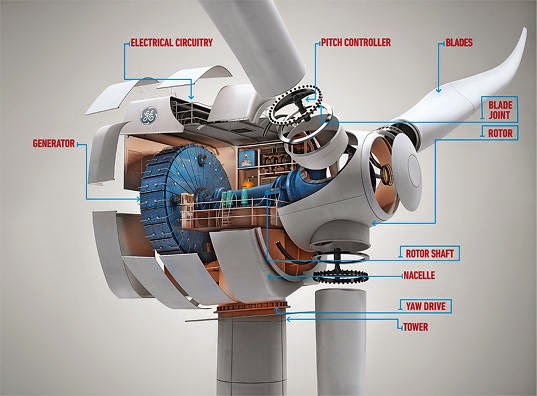
    Horizontal axis wind turbine parts
    Horizontal axis wind turbine parts

    Working of horizontal axis wind turbine

    Working mechanism of the horizontal axis wind turbine is really simple. 

    Wind moving at high speed have kinetic energy in it and when wind strike with the blades of wind turbine its kinetic energy is converted in to the rotational energy of the blades. 

    As blades are attach to shaft and shaft is attach to generator so the rotating blades finally result into the production of electricity by the generator

    Advantages of horizontal axis wind turbine

    Following are the top five advantages of a Horizontal axis wind turbine
    • Relatively high efficiency than vertical axis wind turbine
    • Pitch mechanism can save it from storms
    • Self-starting ability
    • Angle of attack of blades can be change to get maximum energy from slow wind speed
    • All blades work at a time so maximum energy is taken from the wind

    Disadvantages of horizontal axis wind turbine

    Following are 9 disadvantages of Horizontal axis wind turbine

    • High initial cost
    • High maintenance cost
    • Noise problem
    • Very bad visual impact
    • Need huge ground to install
    • Dangerous for bird’s population
    • Cannot be installed near human population
    • Because of long structure of blades and tower they are difficult to transport
    • Create navigation problem when they are installed off shore