Showing posts with label Tidal Power. Show all posts

Jun 26, 2014

Tidal Lagoon


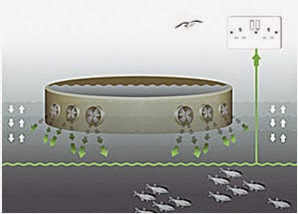
Tidal lagoon is type of tidal power production which is much similar to the tidal barrage, the difference is that tidal lagoon uses a hollow cylindrical structure to create the difference in water water level on opposite sides of wall instead o the the long barrage. 

Tidal lagoon structure is just like a huge hollow cylinder with one or more holes from which water enter and leave the cylinder. These holes have a turbine installed at the half thickness of the cylinder and have capability to produce electricity by rotating in both direction. 


Working of tidal lagoon

Tidal lagoon is install in places in which a water level increase and decrease frequently. When water level increase it start to gather around the walls of the cylinder and as the water level increase potential difference increase on opposite sides of the wall. As water have only few places to enter in the lagoon so it exert all the force at that point.When water start to enter in the lagoon, kinetic energy of the water in transfer into the rotation motion of the blades of the turbine and so the turbine produce the electricity. When water level decrease, water present in the lagoon start to leave the lagoon the same points from which it enter and so turbine rotating in opposite direction and produce the electricity.


Advantages of tidal lagoon

  • Less construction cost than other types of tidal power
  • Less area required for operating than other
  • Less danger to marine life as in not stop the motion of water like tidal barrage


Disadvantages of tidal lagoon 

  • Highly skill labour is required for the construction
  • High maintenance cost
  • Energy production is less as it store small quantity of water


Jun 25, 2014

Dynamic Tidal Power


It is a fact that sea water continuous to flow in two direction one is perpendicular to the shore and one is parallel to the shore. Dynamic tidal power uses the parallel flow to sea water to produce the electricity.  It is most complicate and least sturdy type of tidal power production and it is still in theoretical form no practical work has been done yet. Dynamic tidal power plant is a 30 KM long ‘’T’’ like barrage perpendicular to the shore.


The red section shows the high water tide and blue section the low water tide.

Working of dynamic tidal power

It work just like the tidal barrage the only difference is that the tidal barrage work works with flow perpendicular to the shore and dynamic tidal power works with parallel flow. When the water tide shift the direction after every 12 hour then water start to build up on one side of the wall. When water reached specific height, gates of the barrage is open and water start to flow through the tunnels and make the turbine rotate and the whole process result in the production of clean electricity.


Advantages of dynamic tidal power

  • A single unit can produce from 8 to 15 GW power
  • Because of its T shape it can produce electricity in any direction of water flow
  • It is most reliable that other renewable sources
  • It is more efficient than other tidal power types
  • It is safer for marine life than tidal barrage
  • As head required is lower than the head required for the tidal barrage so it can be installed at low head places where tidal barrage can be installed


Disadvantages of dynamic tidal power

  • Its biggest disadvantage is that it is still not tested
  • Building a 30 km long barrage need high initial cost
  • Although they are less harmful than other tidal but still 30km long barrage can create many problems for marine life


Jun 24, 2014

Tidal Stream Generator


Tidal steam generator is a type of tidal power plant which uses the kinetic energy of the running stream of water to produce the electricity. They are just like wind turbine in their structure and working, the only difference is the place of their working. Tidal stream generator are much more efficient than the wind turbine because of the fact that water is 800 times more than the wind.


Types of turbine in tidal stream generator


Horizontal axis tidal stream turbine

In this type of tidal stream turbine rotation axis of blades is parallel to the direction of water stream flow. Because all three blades rotate at a time so there rapid rotation and low torque make then ahead all other types of turbine.


Vertical axis tidal stream turbine

Axis of rotation in this type is perpendicular to the direction of flow of water stream. Their biggest advantages is that they can produce electricity in any direction of stream flow but their disadvantages is that their one blades always appose the rotation of the turbine.


Reciprocating devices (oscillating hydrofoils) 

In this type blades instead of rotating, oscillate up and down due to the lift created when water flow over and beneath the blade of the turbine


Venturi effect tidal devices

Duct section concentrate the flow from a larger area to a smaller area due to which velocity increase and thus smaller turbine as compared to normal horizontal axis turbine can be used to produce the electricity


Parts of tidal stream generator

Parts of tidal stream generator is much like wind turbine but all parts are packed in a water proof nacelle 

  • Hub
  • Blades
  • Shaft
  • Gears
  • Nacelle
  • Tower
  • Base


Working of tidal stream generator

Working of Tidal stream generator is just like the wind turbine. Fasting moving water particle have kinetic energy which is converted in the rotation motion of the blades. Blades transfer their rotation to the shaft. Gear box increase the rotation motion before it is transfer to the generator to produce the electricity


Advantages of tidal stream generator


  • No visual effects
  • Much safer than wind turbine and efficient as well
  • They can be installed in already build structures present in the stream path.
  • As there is no need of building the barrage so they are much cost effective than other types of tidal power production methods.


Disadvantages of tidal stream generator


  • They are less efficient as compared to other types of tidal wave production methods.
  • Their effect on marine life is still unknown


Jun 13, 2014

Tidal Barrage Power Generation


Tidal power harness by the tidal power plant is the power inherent in tides at sea or oceans that is the power of motion of water actuated by tides. Tides are defined as the increase and decrease in water levels due to the motion of water from one place to the other.

It is a fact that water level increase and decrease during the high and low tide of sea. Tidal barrage power generation system uses this method to produce the electricity.


Components Of Tidal Power Plant

The components of  tidal power plant are as follow

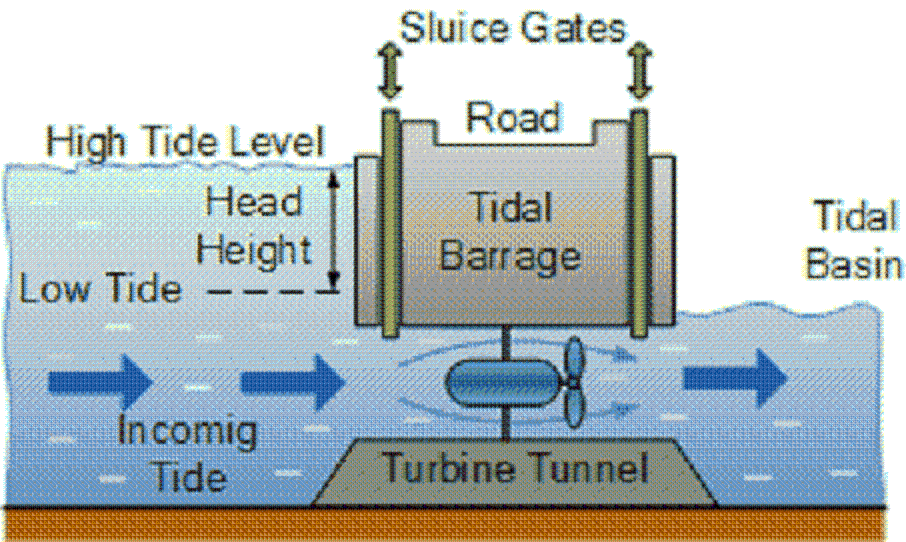
A barrage

A barrage is a small wall built at the entrance of a gulf in order to trap water behind it. It is just like the dam structure. It will gather water by stopping it from going into the gulf when water levels at the sea are high or it will stop water from going into the sea when water level at the sea is low.

Turbines

Turbines are the components which convert the kinetic energy of water in to the rotational energy of the generator which convert rotational energy into electrical energy. They are located in the passageways that the water flows through when gates of barrage are opened

Sluices

Sluice gates are the ones responsible for the flow of water through the barrage

Embankments

They are caissons made out of concrete to prevent water from flowing at certain parts of the dam and to help maintenance work and electrical wiring to be connected or used to move equipment or cars over it

Working Tidal Power Plant

We have divided the working phenomena of tidal barrage generation into seven components

Tidal motion

As said above water level increase and decrease during the high and low tide of sea and this is the most important in this power generation system because it all depends upon the increasing and decreasing level of water

Barrage

Barrage is the wall structure just like the dam structure. Its function is to stop the water on one side during high tide and release it when it reach its maximum value and store it on other side and release it during low tide

Potential energy

I tidal barrage power generation system main source of energy is potential energy of water stored at some high due to the barrage. This energy will be converted to kinetic and then to electrical energy

Opening of barrage doors

Barrage store water during the high tide and when it reached its maximum value doors of barrage are open to let the water flow to the other side

Kinetic energy

As water when stored at some height has some potential energy and when doors are of water atsrt to flow to other side and potential energy is converted in to kinetic energy  which will be used to produce the electrical energy

Using turbines

Up to now potential energy of water is converted into kinetic energy and now this kinetic energy will be converted into the rotational energy of turbine blades when they strike them. Blades attached to a shaft and the shaft is attached to the generator

Electrical energy

Water rotate blades which rotates the shaft and shaft rotates the generator which will produce the electrical energy and one cycle is completed. This process will be continuous till there is difference in the water level

Advantages Of Tidal Power Generation

  • There are many advantages of generating power from the tide; some of them are listed below:
  • Tidal power is a sustainable energy resource.
  • It reduces fossil fuels dependence.
  • It has very less visual impact.
  • Construction of large-scale offshore devices results in new areas of sheltered water, attractive for fish, sea birds, seals and seaweed.
  • Tidal energy is available worldwide on a large scale from deep ocean waters.
  • Tidally driven coastal currents provide an energy density four times greater than air
  • A feature which gives them an advantage over both wind and solar systems is that the tidal currents are both predictable and reliable 
  • Seawater is 832 times as dense as air; therefore the kinetic energy available is much greater than air

Disadvantages Of Tidal Power Generation

  • Unfortunately, there are also disadvantages and limitations to generating tidal power. Some of these are:
  • At the present time there is a problem that the method is not economical.
  • Tidal power systems do not generate electricity at a steady rate and thus not necessarily at times of peak demand
  • Tidal fences could present some difficulty to migrating fish.

Last Words for Tidal Power Plant

So, Our loyal Engineers that was all about Tidal Barrage Power Generation. we are sure you have enjoyed reading it and understood each and everything. 

If you still have any questions please comment below or if you have some better information that we have missed please share with me via the comment box below. 

we will appreciate your efforts. Take A Lot Of Care!

Jun 11, 2014

Four Methods Of Tidal Power Energy Generation


There are few facts that every should know about our planet earth

  • 70% of our planet is occupied by water and 30 % by dry land
  • Water never stops its motion
  • We are facing the energy crises 
  • Use of excess amount of fossil fuel cause the global warming

Problems we are facing can be solved if we see the fact 1 and 2 that is a huge amount of water that never stops.

As we all know that every moving thing have kinetic energy and if we look at the amount of water we have means we have a huge amount of kinetic available every time. 

If these resources are used they can easily solve our problems of energy crises and global warming. Technology which could convert this kinetic energy into electrical energy is called Tidal power

Four methods of Tidal Power Energy Production

  • Tidal steam generators

  • Tidal Barrage 

  • Dynamic Tidal Power

  • Tidal Lagoon 


Tidal Stream Generator for Tidal Power  Energy

Tidal stream generator method is use to extract energy from running tides of water. Many of you may have a visit of a river where you see flowing water at high speed which means that water have huge amount of kinetic energy store in it and we can use that energy to produce electrical energy by tidal stream method

If you have ever seen a wind turbine know how it works them there is no need of learning the working of tidal stream generator method because it works on the same principle. 

But for those did not let us explain high speed moving water when strike the blades of turbine its kinetic energy is converted into the rotational kinetic energy of the turbine blades. Blades cause the generator to rotate which produce the electricity energy


Tidal Barrage for Tidal Power Energy

Look of Tidal Barrage Power Generation is just like a traditional dam and it work on the same principle as the traditional dam do but there is one difference between them traditional dams store water on one side and then convert the potential energy to kinetic energy and use that kinetic energy to rotate the blades to turbine to produce electrical energy and tidal barrage use this method on both sides of the barrage.

Consider a place where water level increase and decrease with the increase and decrease of tides. 

If you constructs a wall from one end to another then when water start to increase it will be stored in one place when it reach its maximum value, gates are open and water starts to flow over the turbine blades and so electrical energy is produce. 

When water level on both sides is same then gates are closed and when water level lowers on one side’s gates are open again and so electrical energy is produce again. This is how this method works 


Dynamic tidal power for Tidal Power Energy

It is a fact that ocean tides don’t operate strictly perpendicular to the shore, but also flow in parallel to the shore as well and Dynamic tidal power use this method to generate electricity. 

It is the most complicated, least well understood tidal power scheme yet conceived. 

This method involve the creating of a long dam-like structure perpendicular to the coast, with the option for a coast-parallel barrier at the far end, forming a large 'T' shape to harvest energy from the tides as they flow parallel to the shore as the diagrams below illustrate. 

Red represents relative high water and blue represents relative low water


Tidal Lagoon for Tidal Power Energy

A newer tidal energy design option is to construct circular retaining walls embedded with turbines that can capture the potential energy of tides. The tidal lagoon scheme is very similar to the tidal barrage method of using tides to generate power. 

In fact, the only real difference between the two is that the tidal lagoon does not block off an entire estuary, but rather makes use of only part of it. 

During the high tide water level around the lagoon will increase and try to move in the lagoon and during low tide water will move outside in both direction it will produce electricity